David Henning Larson

September 27, 1931 – August 25, 2007

Drawings from the 1980s

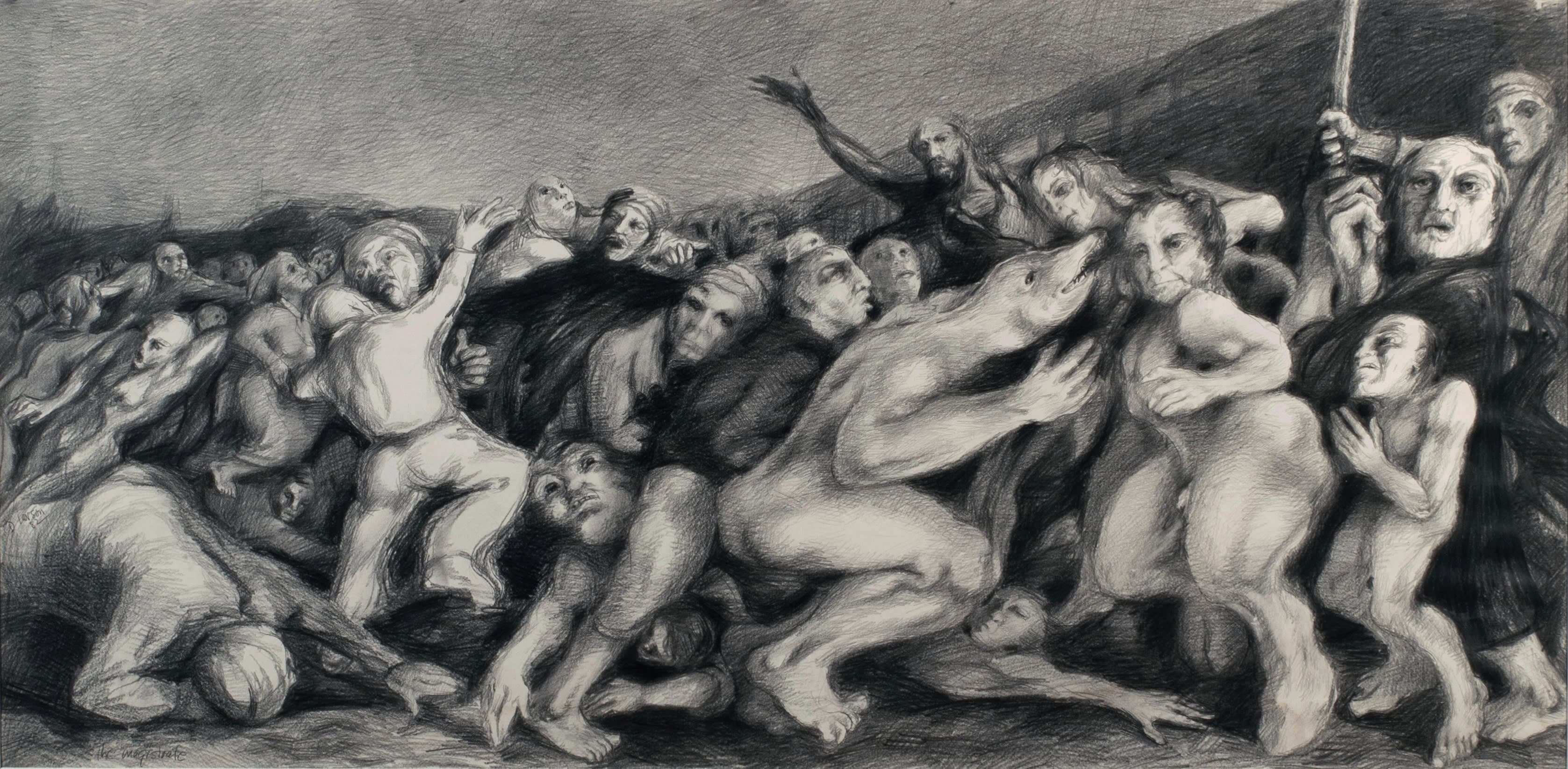
The Magistrate

2248"pencil on paper
The Magistrate

“The Magistrate” in one of a series of works my father, David Henning Larson, produced in the early 1980’s inspired by the great Spanish artist Francisco Goya. Although this ‘conversation’ with Goya took on different forms with different works, basically it involved starting with a composition by Goya, keeping the basic design or 'form' of the work, and using it as the starting point for a new idea - changing the subject matter and making something new and uniquely his own out of it.


My father loved and admired Goya for his brutally honesty and ‘take no prisoners’ portrayal of the human condition, and he was not alone in this regard, for Goya has long been a sort of hero for many artists of the 19th and 20th centuries. Bathers to Giorgione to Cezanne to Manet (small)Goya’s forward-looking and timeless imprint on our collective conscious has been well mulled over by some of the great writers and art critics of our time. The French writer Andre Malraux said of Goya that he is “our greatest poet of blood.” More recently Robert Hughes, in his book about Goya, explains his relevance today by saying, “He speaks to us with an urgency that no artist of our time can muster. We see his long-dead face press against the glass of our terrible century. Goya looking in at a time worse than his.”

It’s hard to top these observations, which I’m quite sure my father would have agreed with. But for my father, the studying, copying and working off Goya’s works were done just as much for formal reasons. I remember David telling me that both of Goya’s major series of etchings, the Capriccios and the Disasters of War, constituted a veritable “text book” of composition and design. Although my father did a number of wonderful drawings in his years leading up to the early 80’s, he was until then primarily a sculptor. Man on Two RocksI think he knew that if was to make drawings, and later paintings, of the first rank, he needed to dive deeper into the fine points of composition and design. So he studied and copied Goya in order to absorb the Spaniard’s compositional lessons, but in doing so applied his own brand of modernism to them. The subject matter, for lack of a better word, would be changed, sometimes subtly, sometimes quite drastically, but the basic structure of Goya’s composition, and sometimes even an echo of the psychic nature of the original work, would still lurk there..

“The Magistrate” - one of the most complex and epic of this series, is a great place to start. The work is loosely based on Goya’s monumental painting ‘The Second of May,’ a strong and interesting work to be sure but a work overshadowed by its twin and more famous and iconic ‘'The Third of May’, Both of these paintings are in the Prado in Madrid, both are impressive, but I think it’s easy to see why the ‘Third’ is well known and admired and the ‘Second’ is not.

Goya's 2nd of May

'The Second of May' by Francisco Goya

Goya's 3rd of May

'The Third of May' by Francisco Goya

The “Third” contains the strong central “Christ-like” figure with his arms raised, facing certain death from the firing squad. The blood on the ground in front of him foretells of his fate at the hands of his machine-like executioners. It is an image that is sticks with you forever. Hughes eloquently described the work as “The picture against which all future paintings of tragic violence would have to measure themselves.” The ‘Second’ however is a different story – it has no clear central figure and is jumble of forms and action. There is a lot of great stuff going on there, but overall it lacks unity. The great British art historian Sir Kenneth Clark even declared it an “artistic failure,” adding that the figures looked staged. Hughes was a little more kind, saying the ‘2nd’ is “a fine painting but not a great one.”

I think the reason my father took on the less famous and more problematic ‘2nd’ is because he found the composition more ‘open ended’ and less conclusive - It offered him room to explore. Its lack of a clear ‘dominant’, while perhaps making it a less successful painting, provided a challenge and an opening – an opportunity for development. I think it’s fair to say many of the works by Goya my father worked off of were not his best works. And I think that’s understandable. How do you take on a masterpiece? How can you hope to improve on a work like Goya's ‘3rd’ - where the form and content have combined in perfect harmony? Perhaps it’s better to find a work that has good ‘bones’ but is lacking somehow, and there is your ticket in.

The Magistrate. pencil on paper. 48" x 22", 1982

Looking at the composition of ‘The Magistrate’ I think it’s pretty easy to see that it was derived from the ‘2nd.’ Both works have the same diagonally sloping wall coming in from the right and the frenzy of the crowd below in the foreground where the conflict takes place. But what really seals the pairing is the presence of a few similar figures, most notably the man on the left, seen from the back, rising up on one leg. There are also a few figures lying on the ground that look similar.

Thematically David stays close to Goya's ‘2nd’ in “The Magistrate” by portraying a conflict. But instead of this conflict being an actual historical event as shown in Goya’s work, David sets up a conflict outside of time. Goya’s ‘2nd’ depicts a ferocious street battle in Madrid on the 2nd of May, 1808 when mercenary troops of the French Imperial Guard, were sent by Napoleon to put down a rebellion by Spanish citizens. In The Magistrate, the inclusion of fantastical, surrealistic figures, the pig-like figure squaring off against a ‘wolf-like’ or carnivorous foe, clearly sets the conflict in a timeless, surreal and dream-like world. Accordingly, ‘The Magistrate” depicts a ‘condition' instead of an event. Now one could argue all of Goya's works are timeless and portray a condition, the ‘human condition’, warts and all, and this is certainly true, but here my father’s intent is to purposefully create a world outside of any historical time. Gone are the trappings of an era or nationality – no 18th century garb, no references to Napoleonic mercenaries on horseback or Spanish peasants. And instead of a specific battle that will be won or lost we have a conflict that seems, at least to me, to be stuck in a state of balance, and that’s what I mean by a condition – there is a sense that nothing is going to be resolved anytime soon. A standoff is taking place that is as old as time, between the forces of anarchy portrayed by the crowd, against the imposed order of officialdom. And while there are no daggers being plunged into people or horses as in the ‘2nd’ by Goya, and the only sword is one being held up symbolically, people are still in danger, some appear to be getting trampled on – there is still a lot at stake.

Stylistically many of the figures in ‘The Magistrate’ have more in common with Goya’s etchings that they do with his historical paintings like the “The Second of May.” It is in the etching series like the ‘Capriccios’ and in his late dark paintings that Goya enters more fully into the world of the surreal, and it this world my father is co-inhabiting, not the world of early 19th century Spain. I think the two central combatants in ‘The Magistrate’ are certainly ‘Goya-like’ and would be at home in one of his ‘Capriccios.’

From a compositional standpoint the work is filled with movement. Waves of humanity surge and swirl forward and back. The oval compositional element in the middle of the pictures acts like an engine, a ‘wave making machine’ if you will, giving the work a feeling of perpetual motion, keeping the eye moving back and forth, up and down. Eventually the composition, through the use of strong diagonals, draws us to the right, to the standoff between the somewhat lizard-like creature and the large androgynous pig with the large thighs. How my father came up with this figure, I don’t know, but I think is the result of a ‘morphing’ of the man on the lower right of Goya’s “Second of May,” with the front half of the white horse .

Magistrate detail right side

In terms of the characters in the drawing, the Magistrate, the man on the right in the dark robe, is in control, but only just, at least this is my take. Behind him his small sidekick prays things will hold up and to the left a tall religious man with his arm raised, appeals for, perhaps prays, for calm (again, my interpretation). But what really makes the drawing work, at least for me, is the nonchalant expression of the Magistrate. He seems surprisingly disinterested - unconcerned about what is happening. Perhaps he doesn’t understand the gravity of the situation or maybe he’s seen it all before and has become a little bored by it all. And this disinterested gaze, directed at the viewer, draws us into the work, inviting us into the drama with a healthy dose of skepticism. My father used to single out a figure or an element in a work of art, either one by him or by someone else and say it “strikes the right note” and subtly or not so subtly, changes the meaning of the entire piece. I think the figure of the Magistrate, in this work, does just that. He slyly takes the attention away from the dominant standoff between the two opposing figures and all the dramatic action in the work.

My father was not a political or social painter. Generally he avoided “like the plague” as he would say, putting any social commentary or ‘meaning’ into a work. To do so, he would say, would risk it becoming illustration, or worse yet, propaganda. But I think a little historical background on what a ‘Magistrate’ is or what, one meant to my father, is helpful. A magistrate is a person from man's imperialistic past, sent to a colony to maintain order over a foreign land. Someone who would govern a province and/or serve in a judicial capacity so as to keep the people under control and provide some sense of stability, while whatever the place had to offer, its resources, could be used/exploited and extracted. This scenario has been played out in a number of places in different times, Africa, the Far East and certainly in South and Central America. In the early 80's the United States’ involvement in the affairs of various Central American countries was in the news. While the U.S. might not have had magistrates there running things at the time, the colonial history of Central and South America was one of foreign domination and control and magistrates played a part in this history. I remember sometime after doing this drawing my father talked to me about the title and this South American historical angle. We also spoke about the work of the Colombian author Gabriel Garcia Marquez, which was set in this era. My father had recently read ‘100 Years of Solitude’ and others works by Marquez, and admired the author a lot. I clearly remember a conversation with him in which he acknowledged Marquez for at least providing some inspiration for ‘The Magistrate.’

Another work that is closely related to ‘The Magistrate’ and also draws inspiration from “The Second of May” is a large drawing called ‘Big Pig.’ Although there are similarities between the two drawings and they clearly have a common lineage, it’s the differences that stand out.

Big Pig. pencil on paper. 38" x 45"

While the ‘Magistrate’ depicts a battle scene, the Big Pig with its central dominant figure, is in essence a portrait. I think my father felt the pig-like figure from ‘The Magistrate’ warranted a new production, so he dressed her up more and gave her a starring role.

In this work, the even more androgynous pig, with its blank, ‘dumb’ expression, takes center stage. The ‘Big Pig’ is an imposing figure, with its head awkwardly attached to its body, gazing blankly at the viewer and wearing a a spiked military helmet harking back to the Austro-Hungarian Empire. Surrounding the pig is a rogues gallery of characters, and it’s this juxtaposition of the blank gaze of the pig, contrasted by the the variety and intensity of the surrounding figures, is what gives this drawing its startling power in my opinion.

The Big Pig takes the idea of being outside of time to another level from the Magistrate. Figures reminiscent of different historical periods co-exist within the drawing. The Big Pig, although clearly a surreal figure, wears a late 1800’s pickelhaube military helmet, something a commander from the Austria Hungarian army might wear. Above and to the right is a soldier swinging a sword taken right from Goya’s 2nd of May. To his left are two tall religious figures that look like they come from the Middle Ages. And swirling around the Big Pig are animals both identifiable and imagined, some sharply drawn, some hazy, and human faces both ghost-like and specific, providing a kind of counterpoint to the drawing as a whole and foil for the dumb blankness of the Big Pig.

The pig figure is a good example of what my father used to call a ‘dumb’ character. He would create a character awkward and almost expressionless, and say “that’s really dumb” and in saying this he meant it as a compliment. I think what he was after with this dumb expression was something akin to Herman Melville’s phrase “dumb blankness, full of meaning” when he described the white whale Moby Dick, where something on the surface first appears blank and expressionless,….. is in fact loaded with meaning, and very deep, but it defies any attempt to decipher it. And this doesn’t have to be an epic figure like Melville’s white whale, it just has to have that blank, benign expression that is seemingly loaded with significance but unexplainable.

And Then What? pencil on paper. 44" x 36"

The large drawing ‘And Then What?’ is probably the work in this series that most resembles its Goya model. The work is clearly based on the Disasters of War etching ‘Tarantula de charlatans’. Goya's etching 'Farandula de Charlatans'Here David simply lopped off the big bird’s head, worked a little on the background characters, added an animal or two, and produced a drawing that I think is surprisingly powerful and original. In Goya’s work the shaman is the big threatening rooster. Perhaps my father felt this figure was a bit too obvious. His Shaman has been transformed into a vague figure hiding underneath a white sheet with tiny fingers raised, leading the mob on to who knows where. The resulting transformation is in some ways just as scary, and perhaps more appropriate for our times. He’s certainly got his followers worked up, but where does his power come from? Again I love the cast of characters he’s assembled for the background in this one - many powerful faces and gestures going on. Also to see this drawing in real life - its large size plays a role in how it is received - is quite an experience.

Family Picnic. pencil on paper. 47" x 33"

I think the drawing farthest removed from the Goya model is ‘Family Picnic’. I must admit that is was only just recently that I was aware that is was based on a work by Goya. I happen to be looking at a book of Goya prints and it dawned on me that ‘Family Picnic’ is based on of all things a bullfighting etching from Goya's ‘Tauromaquia’ series, a work called ‘Modo con que los Antiguos Españoles cazaban los toros a caballo en el campo,’ a rather longwinded title that translates to ‘The way in which the Ancient Spaniards hunted bulls on horseback in the open country.’

For the sake or brevity I’ll refer to the Goya work the ‘Country Bull Hunt.’ You kind of have to squint to see the relationship between both works, but it’s there. The large dark mass shares the same shape, and then with closer looking you’ll spot smaller, shared details that are similar in shape but have become completely new figures or objects. Light patches, like the one in the lower left where a light patch on the horses leg has transformed into a strange looking child. The rest of the horse and rider has been subsumed into the large family pet, the bullfighter’s lance the animal’s horn, and the odd family strangely emerges from the bull and the swirling action of the Goya hunt.

Goya was obviously fascinated by bull fighting, and visited the theme often. There is an element of danger in all of them, and in some Goya manages to sneak in a little humor. Regardless of the tone, all are wildly inventive. But I have to say I think ‘Country Bull Hunt’ is one of Goya’s least memorable bull fighting etchings, and again, perhaps the reason my father chose it to work on it.

In ‘Family Picnic, my father replaces one type of horror with another. While the violence is gone from the bull hunt, how would you like to wake up and discover you were part of this family?! Pretty scary.

My father dabbled in etching in the early 1980’s. He took class in etching at the University of Maine and ended up buying a small etching press. Given his affinity with Goya it’s not surprising that many of the etchings he made were inspired by Goya and his work in the medium. Take for instance this work called “Suzanna and the Elders.”

Susanna and the Elders. Etching on paper. 8" x 11".

This small work is based one of Goya’s etchings from the ‘Caprichos’ series called ‘Pobrecitas!’. Because my father’s work is an etching, the resulting print is a 180 degree reversal of what was drawn/etched on the plate. It’s easier to see the likeness if you take the original Goya’s work and reverse it, as I have done here.

Goya etching 'Pobrecitas'

For me, the power of David's work results from the contrast of the two solid male figures and the wonderful and graceful calligraphy of Suzanna, and especially her face. What stands out for me is the juxtaposition of the two male characters framing the vulnerable but ephemeral Suzanne. Suzanna emerges in her own way the scarier of the characters. Of course the old men are sinister and their motives probably evil, but at least they are figures that can be understood. Whereas Suzanna is vague and defies attempts at definition, both in aesthetic terms as a solid figure, and emotionally, ie understanding her character. Is she just a creation of the old men as she emerges unresolved from the negative space between them. In her vagueness, what exactly is she? Where does she start and end? These aspects of her I find unsettling. Her blankness and the difficulty or reading her is part of the power of this etching and thrusts it into the uncertainty of the modern world.

Stockyard. etching on paper. 12" x 9"

In the etching called ‘Stockyard’ my father takes on a well known and iconic Goya images. It is his take on another Goya’s etching with another wordy title called “Desgracias acaecidas en el tendido de la plaza de Madrid, y muerte del alcalde de Torrejón,’ which translates to ‘Dreadful events in the Front Rows of the Ring at Madrid and Death of the Mayor of Torrejon.’ Goya etching 'Dreadful events in the Front Rows of the Ring at Madrid and Death of the Mayor of Torrejon' Here, a bull has made his way into the front tier of the stands during a bullfight, successfully gored a number of spectators while others flee for their lives. The carnage is right there, front and center.

In ‘Stockyard’, the violence is not physical, but made metaphysical. Goya’s muscular bull, triumphant in the stands, has been replaced by a strange, surrealist creature with an anatomy seemingly incapable of being dangerous. Yet there is still something scary about the figure, with it’s odd directed anatomy and whip-like tail. And the scene in the stands still depicts a kind of carnage, mixed with erotic elements that I think my father meant to be unsettling.

To produce a print that mirrors the original Goya in left to right reading, my father would have had to work off a reversal of the original. I'm not sure how he did this, possibly using a mirror, but it must have taken addition work that my father felt was necessary. I think for him this again, iconic image, could not be produced in reverse and needed to reflect the Goya original

Violence and the barbarity of war was the central theme of Goya’s etching series ‘The Disasters of War.’ My father used a number of them as starting points for new works. Take for instance the etching ‘Job’, which is based on Goya’s etching ‘Barbaros!’ My father has transformed this firing squad and victim image into a work with a biblical theme. From violence and death to strange wonder.

'Job' etching on paper. 12" x 9"

I wonder if in looking at his etching, the ‘ghost’ of the original Goya work was in the back of David's mind, haunting the transformed image? Viewers unfamiliar with the original Goya, and unaware of its firing squad start, wouldn’t have that dilemma.

'Cave' etching on paper. 12" x 9"

David’s work ‘Cave’ has a similar lineage. It is based on another Disaster of War etching called “No se Puede Mirar,’ and also features victims in the line of fire, this time an individual about to be executed. But in David’s work, the guns have disappeared. All that is left are surreal figures writhing in a cave. Again, does the imprint of the original work affect how we see this image, if we are aware of it? Does it matter? Shouldn’t be be able to just view a work based on what is in front of our eyes, without bringing emotional baggage to the table?

Switching gears to more upbeat works, consider the large drawing called ‘Bird, Donkey and Mellonhead.’

'Bird, Donkey and Mellonhead' - pencil on paper. 48" x 36"

Given the upbeat nature of this work, it might come as a surprise it is based on a Disaster of War etching called ‘Y esto también,’ which depicts refugees, presumably fleeing fighting, carrying on their backs all their possessions. That David would come up with this flirtatious encounter from the war image shows just how creative my father’s imagination was. I also love how he kept the small animal lower left largely intact, only transforming the small pig into a rodent of some sort. The interaction between the bird-like female figure and the male donkey feature is clearly the main focus of the work. It brings a smile to my face. But I think the key to this image working, and retaining the mystery all successful art needs, is the figure of the Mellonhead. Because of it’s ambiguous nature in the otherwise innocent and fairy-tale like scene, it introduces a cloud of uncertainty to the image - it’s impossible to explain logically yet it seems to work, at least for me.

'June, the Baby' - pencil on paper. 29" x 41"

Another large drawing with it’s own aura of magic is ‘June, the Baby’. It’s based on an early painting by Goya called ‘The Strolling Players’, a painting the Prado Museum in Madrid says on its website says is a satire on the Italian Commedia Dell’arte tradition. My father has transformed this image into a sort of Madonna and Child scene, with its biblical implications. But he has also added some surreal elements that add a note of dissonance to the setting. Seeing this work on the internet is one thing, but given it’s fairly large size it makes a real strong impression when viewed in person.

Dance after Goya I

Next I'd like to highlight two works that are clearly related but stylistically very different. ‘Dance After Goya’ is an almost exact copy of Goya’s fantastic “Merry Follies”, an etching from his late Disparates series. Goya’s work leaves me chuckling at the audacity of the composition, the characters and the gestures - the joy in it, yet at the same time the biting humor of it all. My father worked very hard to capture the original expressions and gestures and I think he was largely successful. Rarely does my father, in making a copy of a classic work, pay so much attention to details. He used to tell me when copying a work to keep it loose, concentrate on capturing and understanding the form of the original work, figure out why the composition works and don't get caught up in the small details. So for my father to stick so closely to the Goya original in this case means I think that for him at least the details in this work were just as important as the whole and he could learn from them. I think rarely are copies successful in capturing the magic of the original, but I think my father was quite successful in this case

With this in mind, consider the follow up work I call ‘Dance after Goya II’.

Dance after Goya II

I don’t think there is much I have to say about this work, which never fails to bring a smile to my face. Goya's merry band of revelers have danced their way into the jazz age.

My father's close study, working directly with his compositions, took place in the early 1980's, but his love of Goya's work and the influence his work had on my father lasted forever. In one of my father's last sketchbooks from 2005 - 2997 is this drawing.

Page 26 from a sketchbook of 2005 - 2007. pencil on paper. 12" x 9"

It's based on an etching from Goya's Disasters of War series called 'Estragos de la Guerra'. As you can see, both feature piles of dead bodies in ruble. What I find interesting is the change of setting. Instead of the victims lying in some sort of barn or wooden structure, my father has given them a modern setting, placing them in the ruble of a collapsed building, among concrete beams. The tragedy is the same either way, and nothing really changes.

How he came up with this particular transformation, or all the others I’ve illustrated, I don’t know. Was it instigated by something he simply saw, ie an optical inspiration? Or was the process of transformation based on philosophical or historical ideas of change and alteration? While I don’t know the answer to these questions, I think the result of this dialogue with Goya not only provided a learning experience for my father, but yielded a rich trove of images that, going forward, speak for themselves. Soren Larson